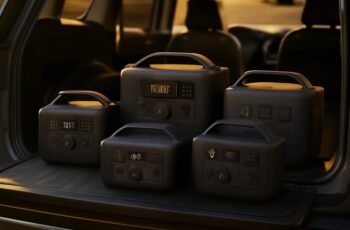
Nearly 20% of power outages last long enough to threaten food safety, so a reliable portable power station isn’t a luxury—it’s insurance. This year’s best units mix long-life LiFePO4 batteries, true UPS transfer under 20 ms, high surge output for compressor startups, and fast dual charging. We’ll compare real runtimes, expansion options, and app controls that prioritize fridge power—even for 12V coolers—so you can keep essentials cold anywhere without guesswork.
Key Takeaways
- Choose LiFePO4 models (3000+ cycles) with 1,000–3,000Wh for 6–24+ hours of typical fridge runtime, depending on size and ambient temperature.
- Ensure inverter surge capacity exceeds fridge startup (often 2,000–3,400W) to prevent trips; continuous output of 1,800–3,600W suits most homes.
- Prefer fast recharge: EcoFlow DELTA 2 hits 0–80% in 50 minutes; DELTA 2 Max in 43 minutes via dual AC+solar; Jackery 3000 in ~1.7 hours hybrid.
- Look for UPS capability (≤20ms transfer) to avoid compressor restarts; Jackery HomePower 3000 and similar units provide reliable bridging.
- For solar resilience, target 400–500W+ input; EcoFlow 400W IP68 panel is efficient, but single-panel refills can take 5+ hours.
EF ECOFLOW DELTA 2 Max Solar Generator with 400W Panel


If you need a fast-charging, fridge-ready powerhouse for outages or off-grid trips, the EF EcoFlow DELTA 2 Max with the 400W panel stands out. We get 2048Wh of LFP capacity, 2400W output (X-Boost 3400W), and 15 outlets—enough to run a refrigerator and essentials. It charges fast: 0–80% in 43 minutes using dual AC+solar, or 1.1 hours via AC. The 400W IP68 panel hits up to 23% efficiency, topping up in about 5.1 hours; add a second panel to halve that. The app lets us prioritize solar, monitor alerts, and schedule use. With 3000 cycles and a 5-year service, it’s reliable and ready.
Best For: Homeowners, RVers, and campers who need a fast-charging, high-capacity solar generator to power a fridge and multiple essentials during outages or off-grid trips.
Pros:
- 2048Wh LFP battery with 2400W output (3400W X-Boost) runs fridges and most household devices via 15 outlets
- Extremely fast charging: 0–80% in 43 minutes with combined AC+solar; 1.1 hours via AC alone
- Rugged 400W IP68 solar panel (up to 23% efficiency) with app controls for solar priority, alerts, and scheduling
Cons:
- Heavier setup (power station 50.6 lb; 400W panel 35.3 lb) reduces portability for frequent moves
- Single 400W panel takes about 5.1 hours to top up; buying a second panel adds cost
- Premium price point; availability and stock can vary
Jackery HomePower 3000 Portable Power Station (3072Wh, 3600W)

Serious home-backup planners and RVers will appreciate the Jackery HomePower 3000 for its rare mix of 3600W output (7200W surge) and a 3072Wh LiFePO4 battery that can keep a full-size fridge cold for 1–2 days. We like its TT-30 RV port, dual 100W USB-C PD, plentiful AC, USB-A, and DC outputs, plus a ≤20ms UL-certified UPS for routers, security cams, and medical fridges. It recharges fast—1.7 hours via hybrid AC/DC or 2.2 hours on AC. Solar’s slower: two 200W panels hit about 80% in 9 hours. At 59.5 pounds, it’s hefty but compact, durable, app-connected, and tax-credit eligible.
Best For: Serious home-backup planners and RVers who need high 3600W output, a large 3072Wh LiFePO4 battery, fast recharging, and an RV-friendly TT-30 port with UPS capability.
Pros:
- 3600W output (7200W surge) with 3072Wh LiFePO4 battery powers essentials; can keep a full-size fridge cold for 1–2 days
- Fast recharge: ~1.7 hours via hybrid AC/DC or 2.2 hours on AC; app shows real-time input/output and ETA
- UL-certified UPS (≤20ms) and versatile ports including TT-30 RV, dual 100W USB-C PD, AC, USB-A, and DC
Cons:
- Heavy at 59.5 pounds, which limits portability for frequent moving
- Solar charging is slower; two 200W panels reach ~80% in about 9 hours under good sun
- High cost of SolarSaga panels and extra cables/splitters; setup can be complex and adds to total price
Jackery Explorer 1000 v2 Portable Power Station

Need a compact powerhouse that can start and run a fridge without drama? The Jackery Explorer 1000 v2 delivers 1,500W AC output with 3,000W surge, plus a 1,070Wh LiFePO4 battery that lasts over 10 years (4,000 cycles to 70%). At 23.8 lbs with a foldable handle, it’s road-trip and emergency ready.
We like the three pure sine AC ports, dual USB-C (100W PD), USB-A, and a 12V car port. ChargeShield 2.0 and the app add fast 1-hour emergency charging (default 1.7 hours), quiet 30 dB mode, and efficiency settings. Note: solar panel not included and solar input is Jackery-only. Includes AC cable and manual.
Best For: Campers, RVers, and emergency-prep users who need a portable, long-lasting power station that can start and run appliances like fridges or small AC units with fast, app-controlled charging.
Pros:
- 1,500W AC output (3,000W surge) with three pure sine wave outlets; handles fridges, electric pots, and small AC units.
- 1,070Wh LiFePO4 battery rated for 4,000 cycles to 70% (10+ year lifespan) in a 23.8 lb portable form with foldable handle.
- Fast charging options via app (1-hour emergency charge, quiet 30 dB mode, efficiency settings) plus dual 100W USB-C PD.
Cons:
- Solar panel not included and solar input is compatible only with Jackery panels.
- App requires account management and may add complexity for some users.
- Display size and price may not satisfy all buyers; AC full-charge default is 1.7 hours unless using emergency mode.
Jackery HomePower 3000 Portable Power Station with Solar Panels
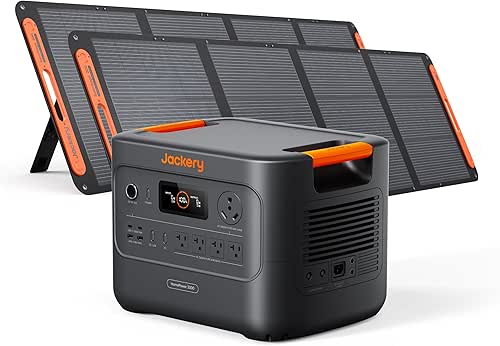
Looking for a true home-backup contender that can keep a full-size fridge cold for 1–2 days? Jackery’s HomePower 3000 delivers with 3600W output (7200W surge) and a 3072Wh LiFePO4 battery. We’ve powered fridges, routers, lights, and fans, and seen ~36 hours on a fridge alone. Its ≤20ms UL-certified UPS keeps essentials running during outages. Recharge fast: 1.7 hours hybrid AC/DC or 2.2 hours AC. Two SolarSaga 200W panels can add up to 80% in about 9 hours of sun. You get 4 AC outlets, USB-A/C, DC, and a TT-30. At 59.5 pounds, it’s portable, app-connected, 4,000-cycle durable—though panel accessories can add cost.
Best For: Homeowners, RVers, and preparedness-focused users who want a portable, fast-recharging power station that can keep essentials (like a full-size fridge) running for 1–2 days and provide seamless UPS backup.
Pros:
- 3600W output (7200W surge) with 3072Wh LiFePO4 battery and ≤20ms UL-certified UPS for reliable home and RV backup
- Fast recharge options: 1.7 hours hybrid AC/DC or 2.2 hours via AC; app control with WiFi/Bluetooth monitoring
- Versatile I/O including 4 AC outlets, USB-A/C, DC, and TT-30 RV port; durable 4,000-cycle LiFePO4 chemistry
Cons:
- Heavier unit at 59.5 pounds reduces grab-and-go portability
- Solar expansion can require pricey branded panels, splitters, and cables; panel pricing higher than some competitors
- Solar charging speed depends heavily on sunlight; two 200W panels take about 9 hours to reach ~80% in good conditions
EF ECOFLOW DELTA 2 Portable Power Station (1024Wh)

If we want a compact unit that can actually handle a full-size fridge during outages, the EcoFlow DELTA 2 stands out with 1800W AC output and a durable 1024Wh LiFePO4 battery. At 27 pounds, it’s portable yet substantial, with 15 outlets (including 100W USB-C) to power 90% of appliances.
We love its speed: 0–80% in 50 minutes from the wall, or up to 500W solar for quiet, fume-free charging. The LFP pack offers 3000+ cycles and a smart BMS for safety. Need more runtime? Expand to 3kWh. In the box: power station, AC cable, manual, and a 5-year customer service promise.
Best For: Homeowners, campers, and RV users who need a fast-charging, portable power station that can run most household appliances—including full-size fridges—during outages or off-grid trips.
Pros:
- 1800W AC output (2700W surge) powers 90% of appliances; 15 outlets including 100W USB-C
- Ultra-fast AC recharge: 0–80% in 50 minutes; supports up to 500W solar; expandable to 3kWh
- Long-life LiFePO4 battery with 3000+ cycles and smart BMS for safety
Cons:
- 27-pound weight is portable but hefty for frequent carry
- Additional batteries and solar panels add cost for extended runtime
- Fan noise and accessory cable length (e.g., XT60 extensions) can be minor annoyances
OUPES Exodus 1200 Portable Power Station (992Wh, 1200W)

With a 992Wh LiFePO4 battery and a true 1,200W output (3,600W surge), the OUPES Exodus 1200 hits the sweet spot for keeping mid-size refrigerators cold through outages while staying portable at just 23 lbs. We get three pure sine AC outlets, dual 140W USB-C PD, USB-A, and a car port—10 outputs total. Expect about 25+ hours on a typical fridge, plus UPS switchover under 20ms for sensitive gear. It recharges fast in about 2 hours via AC, supports up to 240W solar, and allows pass-through. The LiFePO4 cells promise 3,000+ cycles, backed by a 5-year warranty and solid safety protections.
Best For: Campers, RVers, and homeowners who need a portable yet robust backup power station that can run essentials like fridges, laptops, and tools with fast recharge and UPS protection.
Pros:
- 992Wh LiFePO4 battery with 3,000+ cycles, 5-year warranty, and <20ms UPS for sensitive devices
- 1200W continuous/3600W surge across 10 outputs including three AC, dual 140W USB-C PD, USB-A, and car port
- Rapid ~2-hour AC recharge, 240W solar support, and pass-through charging for uninterrupted use
Cons:
- 1200W continuous output may be limiting for high-draw appliances running simultaneously
- Solar input capped at 240W, so full solar recharge can take several hours
- At ~23 lbs, still somewhat heavy for ultralight travel or frequent hand-carrying
Jackery Portable Power Station Explorer 300 (293Wh)

Compact power meets fridge-friendly reliability—Jackery’s Explorer 300 packs 293Wh with two pure sine wave AC outlets (300W, 500W surge), making it a smart pick for mini fridges or short outages when portability matters. At 7.1 pounds, it’s easy to carry and quiet, with clean power that protects electronics. We get versatile ports: 1 PD 60W USB‑C (in/out), 1 Quick Charge 3.0, 1 USB‑A, and a 12V car port, powering up to six devices.
Recharging’s fast: to 80% in about 2 hours using wall plus 60W USB‑C. It supports car and SolarSaga 100W solar with MPPT, plus pass‑through charging. Not for high‑draw appliances.
Best For: Campers, road‑trippers, and outage‑preppers who need a lightweight, quiet, fridge‑friendly portable power station for small devices and short backups.
Pros:
- Compact 7.1 lb design with 293Wh capacity and two pure sine wave AC outlets (300W, 500W surge) for clean, device‑safe power
- Fast recharging to ~80% in about 2 hours via wall plus 60W USB‑C; supports car and 100W solar (MPPT) with pass‑through charging
- Versatile I/O: PD 60W USB‑C (in/out), Quick Charge 3.0, USB‑A, 12V car port; powers up to six devices simultaneously
Cons:
- Not suitable for high‑draw appliances (e.g., induction cooktops, blenders, large heaters)
- Limited runtime for larger loads due to 293Wh capacity and 300W max output
- Solar panel sold separately; full solar recharge can be slow depending on conditions
Anker SOLIX C1000 Portable Power Station

Looking for a fridge-safe powerhouse that recharges faster than anything in its class? We like the Anker SOLIX C1000 Portable Power Station for its 1800W output (2400W peak) and 1056Wh capacity—plenty to start and run most refrigerators. SurgePad tech handles 99% of appliances, while LiFePO4 cells deliver 3,000 cycles for a 10-year lifespan.
Recharging is the star: 80% in 43 minutes and a full charge in under an hour via AC, all controllable in the Anker app. Solar’s fast too—600W for a full top-up in about 1.8 hours. It’s 15% smaller, packs 11 ports, and includes AC, car, and solar cables.
Best For: Homeowners, RVers, and campers who need a compact, fridge-safe backup power station with ultra-fast AC and solar recharging for outages and off-grid use.
Pros:
- 1800W output (2400W peak with SurgePad) powers 99% of appliances, including most refrigerators
- UltraFast AC recharge to 80% in 43 minutes; full charge in under 1 hour
- Long-lasting 1056Wh LiFePO4 battery with 3,000 cycles and versatile 11-port design
Cons:
- Fast recharging control requires the Anker smartphone app
- Optional solar panels not included (connector included only)
- 1056Wh may be limited for extended multi-day outages without solar or generator backup
EF ECOFLOW DELTA 2 Portable Power Station
Serious about keeping a full-size fridge running through outages or on the road? The EF ECOFLOW DELTA 2 delivers with 1024Wh of LiFePO4 storage, 1800W continuous AC (2700W surge), and 15 outlets at 120V. We can recharge absurdly fast—0–80% in 50 minutes, full in 80—or sip sunshine via up to 500W solar. Its LFP battery offers 3000+ cycles and a smart BMS for safe, quiet operation.
At 27 pounds, it’s portable yet substantial, and expandable to 3kWh for longer outages. In the box: power station, AC cable, manual, and 5-year customer service. Users praise speed, outputs, solar flexibility, and reliability; price draws mild debate.
Best For: Home backup, RV/camping, and off‑grid users who need fast recharging, high 1800W output, and long‑life LiFePO4 power with optional solar and expandable capacity.
Pros:
- Ultra‑fast AC charging (0–80% in ~50 minutes; full in ~80) and up to 500W solar input
- 1800W continuous/2700W surge powers most household appliances; 15 outlets including 120V AC and 100W USB‑C
- Durable LiFePO4 battery with 3000+ cycles and smart BMS; capacity expandable from 1kWh to 3kWh
Cons:
- 27 lb weight is portable but hefty for frequent carry
- Price can be high, especially with extra batteries or solar panels
- Fan noise and accessory cable length (e.g., XT60 extensions) may be concerns in some setups
BougeRV 277Wh Portable Power Station with Dynamic Display Panel
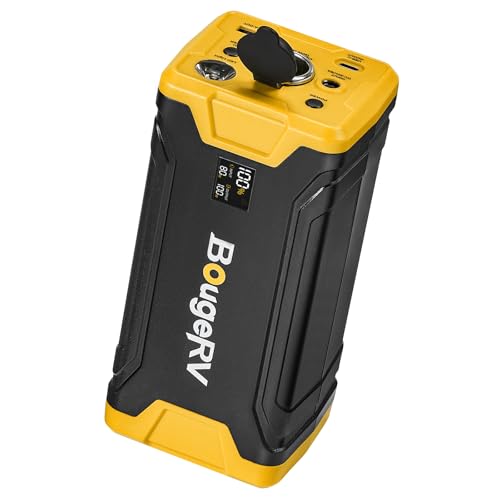
Best for powering 12V car fridges on the go, the BougeRV 277Wh Portable Power Station packs a 277Wh battery, a cigarette-lighter output compatible with about 95% of 12V refrigerators, and a dynamic display that shows exact remaining power from 0–100%. We like its 3.09-pound build, pass-through capability, and ECO Mode synergy with BougeRV CRPRO fridges for 9+ hours of cooling. Recharging’s flexible: solar up to 100W in about three hours, plus AC, DC, and USB-C. Use the included 60W USB-C cable or a wall plug for faster top-ups. Reviews note portability and runtime, but some report slow charging and occasional heat concerns. Two-year tech support included.
Best For: Travelers and outdoor enthusiasts who need a lightweight, portable power station to run 12V car refrigerators and small devices with clear, real-time battery info.
Pros:
- Lightweight 3.09 lb design with 277Wh capacity and pass-through charging for continuous use
- Cigarette-lighter output compatible with about 95% of 12V fridges; ECO Mode pairs with BougeRV CRPRO for 9+ hours
- Fast, flexible recharging: up to 100W solar in ~3 hours, plus AC/DC/USB-C; dynamic display shows exact 0–100% power
Cons:
- Some users report slow charging if not using a proper wall charger or high-wattage input
- Occasional heat concerns noted in reviews during charging/use
- USB-C recharge can be lengthy; may require buying a faster wall plug for best results
Factors to Consider When Choosing Portable Power Stations for Refrigerators
As we pick a power station for a fridge, we’ll size for power output headroom and battery capacity so it runs steady, not just on paper. We’ll check surge/startup watts, UPS capability and transfer time to avoid outages, and whether it offers pass-through power. We’ll also weigh charging speed options—AC, solar, and car—to match how and where we’ll recharge.
Power Output Headroom
While wattage numbers can feel abstract, we should leave comfortable headroom between a fridge’s needs and a power station’s limits. Most refrigerators run around 100–250W, but compressors spike several times higher at startup. To stay safe, we match continuous output to the running load plus a margin, and verify surge capacity for those brief peaks.
A practical target: choose a unit with 600–1800W continuous output; many models in that range can handle typical fridges. For broader compatibility, 1800W continuous with 2700–3600W surge supports most household units without tripping. We also look for efficient, pure sine wave inverters and LiFePO4 batteries, which deliver stable power and tolerate frequent cycling. That combination keeps compressors happy, prevents overload faults, and maintains reliable, quiet operation.
Battery Capacity Needs
How much battery do we really need to keep a fridge cold through an outage? We start by matching capacity to expected runtime. A 1,000–1,100Wh power station can keep a typical refrigerator going for about 6–12 hours. If we want overnight or a full day, stepping up to 2,000–3,000Wh pushes coverage to roughly 12–24+ hours with moderate door openings and typical room temps.
We favor LiFePO4 batteries for their longevity and consistent performance—often 3,000–4,000+ cycles—and their steadiness under heavier compressor loads. For multi-day resilience, we prefer modular systems that let us add expansion batteries, scaling to 2–4kWh or more as needed. When we size capacity, we also factor in the fridge’s average watt draw and ambient temperature, which directly impact duty cycle and runtime.
Surge and Startup
Even when a fridge sips modest power once running, its compressor demands a sharp surge at startup, and we have to size for that spike. The power station’s surge capacity must exceed the refrigerator’s startup wattage to avoid tripping, dimming, or resets. Many AC-motor fridges pull several thousand watts for a split second, so we shouldn’t rely on continuous ratings alone—confirm the inverter’s peak output window and duration.
LiFePO4-based stations often manage these bursts well, but we still need to verify the published peak range (for example, 1800W–3400W) against our model’s startup profile. Inverter design and battery management matter, too: efficient, well-cooled inverters recover faster and maintain voltage stability. Hybrid or dual-input charging that quickly replenishes after surges helps keep the compressor cycling without interruption.
UPS and Transfer Time
We’ve sized for startup spikes; now we need the power station to keep the fridge running when the grid blinks. That’s where UPS behavior and transfer time matter. A true UPS bridges outages without dropping output, so the compressor doesn’t stall and sensitive controls don’t reset. Look for sub-20 ms transfer time; longer gaps can cause a restart or warm cycle.
Transfer time isn’t about battery size. It depends on the inverter/charger design and the load already on the system. Heavier continuous power capability (think 1800W–2400W) often rides a switchover more smoothly, handling the brief surge as the inverter takes over.
Vendors tout fast wall recharging with UPS modes; verify the transfer path stays uninterrupted when switching both directions between grid and battery.
Charging Speed Options
Why obsess over charging speed? Because a warm fridge means spoiled food. We should prioritize stations that recharge fast enough to outpace daily fridge draw. Many top models hit 0–80% in under an hour—often branded “UltraFast” or “7x faster AC charging”—and some reach 0–100% in about 80 minutes via fast AC.
Dual charging is our favorite: combine AC and solar to get to 80% in roughly 43–50 minutes, then top off while still running the fridge. Look for 500–600W solar input; with ideal sun, 600W arrays can refill a unit in under two hours.
Expansion batteries matter too. They boost runtime and often unlock higher combined input for quicker initial charging. Finally, pass-through charging keeps the refrigerator powered while the station recharges.
Conclusion
Wrapping up, we’ve zeroed in on portable power stations that keep fridges humming wherever we go—at home, on the road, or off-grid. With LiFePO4 longevity, fast charging, true UPS transfer, and smart apps, these picks make power management feel effortless. From heavy-duty backup to compact 12V options, we can match capacity to need and stay ready. Pair with solar for longer runtimes and peace of mind. Because warm milk in a blackout is a tragedy of epic proportions.