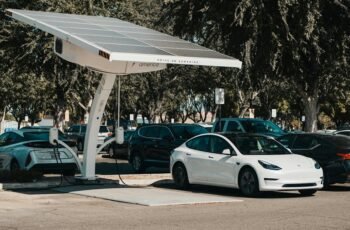
If you don’t harness it, the sun will do all the charging for you—eventually leaving your EV craving power at the worst times. You’ll set up app-controlled solar charging to schedule, throttle, and monitor how solar output feeds your car. The idea sounds simple, but the real value comes as you balance home load, tariffs, and real-time panels. Ready to connect the dots and keep your energy flow in check?
Understanding Solar-Charging Basics
Understanding how solar charging works starts with the core flow: sunlight hits the panels, DC power is produced, a charge controller tunes the output to match the battery, and the stored energy can then be used directly or via an inverter when you need AC power.
You understand that solar panels convert sunlight into DC electricity, using silicon PV cells. Batteries store this electricity for later use, ensuring availability when sun isn’t shining. A charge controller regulates current and voltage from panels to batteries, preventing overcharging and damage. The inverter converts stored DC into AC for household appliances. Wiring and connectors link components, enabling efficient and safe energy transfer. You also recognize panel types and maintenance: higher-efficiency monocrystalline panels perform better in low light, proper panel positioning, cleanliness, and wiring quality all influence output.
Setting Your Charging Schedule for Peak Solar
To set your charging schedule for peak solar, start by aligning EV charging with periods of abundant solar energy and low net grid load. You can dynamically adjust schedules to match solar availability, targeting energy valleys to maximize solar utilization. When solar production is limited, reduce charging rates; when it’s abundant, increase them to balance demand and supply. Consider your arrival/departure times and required charging duration to fit solar windows without sacrificing reliability. Solar-based scheduling lowers peak grid loads by shifting charging away from high-demand periods. Use real-time and forecasted solar data to adapt times, enhancing energy cost savings and grid stability. Integration with ToU tariffs further minimizes costs by prioritizing solar slots and reducing expensive non-solar charging. Five solar-powered EV charging stations were evaluated in the IEEE 33-bus distribution system.
Balancing EV Charge Rate With Home Usage
You’ll want to balance your EV charge rate with your home usage to avoid tripping breakers and high peak charges. Dynamic load balancing and smart controls let your charger throttle when A/C, appliances, or solar shifts spike. This approach keeps solar during the day and minimizes grid draw, setting up efficient, reliable power for both home and EV.
Solar-Auto Balance
Solar-Auto Balance keeps EV charging in sync with your home’s solar generation and consumption. You’ll have EV charging power adjust in real time, prioritizing solar over grid use and reducing dependence on the grid. Smart chargers, solar inverters, and EMS work together to modulate current, sharing solar data and household load to balance demand. When solar is abundant, charging speeds up; when it’s scarce, they pull back. Integration with home storage lets you shift charging to times when solar is low, maximizing self-consumption. This approach helps cut energy costs and keeps circuits from overloading. You can set max charge rate, desired completion, and solar usage targets, while monitoring through apps or EMS dashboards.
Home Load Optimization
When you balance EV charging with home loads, you adjust the EV’s charge rate to prevent spikes during peak household use, reducing grid stress. You’ll typically favor slower charging points around 7 kW to keep home energy use steady, while using high-power fast chargers sparingly to maintain balance. Dynamic rate adjustments optimize energy allocation between household needs and EV charging, guided by smart control and predictive analytics. Algorithms blend slow and fast charging to maximize solar utilization while avoiding overload.
- Prioritize gradual charging during peak home activity to smooth demand.
- Sync EV charging with solar generation forecasts and real-time consumption.
- Use dynamic scheduling to shift charge sessions to low-load periods for efficiency.
Enabling Maximum Power Boost and End-of-Day Top-Ups
You can maximize energy capture with MPPT-based boosts and end-of-day top-ups, ensuring your battery finishes the day near full when sun fades. We’ll explore maximizing MPBT impact, how solar-balanced charging plans play into that, and practical GC-level steps you can take in app controls. This discussion starts by linking boost techniques with daily energy management to optimize both immediate charging and long-term health.
End-of-Day Top-Ups
End-of-day top-ups guarantee your home battery finishes charging after solar generation wanes, securing maximum stored energy for overnight use. You set intelligent schedules so the system finishes the day with full capacity, ready for quiet evenings or outages. Weather variability and shorter daylight are addressed by automatic top-ups, maintaining reliability without extra effort. A fully charged battery at day’s end reduces grid dependence and keeps evening power steady. By prioritizing off-peak or low-rate hours, you minimize costs while supporting grid stability.
- Use app scheduling to target full capacity by sunset
- Let smart management trigger top-ups via SOC and temperature safeguards
- Align timing with TOU tariffs and weather forecasts for ideal efficiency
Maximizing MPBT Impact
MPBT can dramatically boost late-day charging by temporarily overriding the standard MPPT curve to push more current into the battery as daylight fades. You pair MPBT with MPPT to surge toward the panel’s maximum output during critical windows, pre-loading energy before night demands grow. MPBT uses intelligent timing to avoid overcharge, while MPPT continuously tracks the optimum point under changing conditions like temperature and sun angle. Together, they maximize energy transfer and battery readiness for heavy nighttime use, with app controls enabling scheduling and safer limits.
| Scenario | Benefit |
|---|---|
| Late daylight window | Faster pre-charge |
| Cloudy/short days | Maintains charge momentum |
| High overnight load | Reduces shortage risk |
Solar-Balanced Charging Plans
Solar-Balanced Charging Plans optimize when and how you top up during fading daylight, combining maximum power boost with precise end-of-day top-ups. You leverage forecasted solar peaks and real-time data to time charges, smoothing shifts as sunlight wanes and grid rates rise. End-of-day top-ups use surplus daytime energy or off-peak grid power to keep SoC ready for tomorrow, reducing reliability risks. By coordinating with TOU pricing and SBP credits, you minimize costs while maximizing solar usage. The approach supports calmer loads at sunset, lowers grid dependence, and extends battery health through unified voltage schemes. Real-time monitoring and ISO 15118 communication enable seamless, automatic adjustments for sustained performance.
- Align daytime boost with forecasted generation
- Schedule end-of-day top-ups via surplus or off-peak energy
- Integrate pricing, forecasting, and control for efficient flow
Coordinating With Battery and Charge Controller Protections
Coordinating overcharge, overdischarge, and current/voltage protections between the battery and the charge controller is critical for long-term health and safe operation. You set overcharge cut-off voltages per manufacturer notes, and your controller halts charging when safety thresholds are hit. Adjust limits for each chemistry, like LiFePO4 or lead-acid, to keep cells balanced. Maintain a floating charge after absorption to prevent surface charge and preserve health. Align charge current with battery capacity to avoid overheating. For discharging, set minimum voltage cut-offs and guarantee the LVD engages before deep depletion. Coordinate discharge stop voltages with specs, and monitor remotely if possible. Integrate with BMS for dynamic cuts, and keep firmware current to preserve protection features.
Leveraging Time-of-Use Tariffs for Savings
Time-of-use tariffs let you save by shifting your energy use to cheaper periods. With TOU, you time your charging and discharging to exploit lower prices, aligning solar generation with off-peak or shoulder windows to maximize savings. You’ll see bigger benefits when your solar peak lines up with lower-cost periods and when storage can buffer front-loaded daytime generation for evening peaks. Batteries and smart controls automate shifts, reducing manual tweaks and optimizing grid interaction. Higher price differentials between peak and off-peak amplify gains, especially for solar homes. Smart meters track usage, while apps coordinate solar, battery, and grid activity to minimize charges and support grid stability.
- Align solar production with lower-cost periods for maximum savings
- Use smart controls to automate TOU-based charging/discharging
- Leverage storage to reduce peak-grid reliance and expenses
Integrating Open Protocols and External Power Control
Open protocols and external power control enable true interoperability and flexible grid interactions for your EV charging setup. By embracing OCPP, OSCP, OpenADR, and related standards, you gain vendor neutrality and seamless communication across chargers and central management systems. This interoperability reduces lock-in, letting different brands work together within a single network. OSCP provides real-time grid capability, pricing, and demand forecasts to shape charging dynamically, including 24-hour-ahead adjustments to preserve stability. Combine OCPP with OpenADR to transform stations into flexible grid resources guided by events and price signals. Integrate with local HEMS for localized, smart control, and leverage DER features in newer OCPP versions for V2G and optimized energy flows. Open protocols also enable secure, remote management and scalable multi-entity coordination.
Monitoring Energy Flows and Charge Status in Real Time
Real-time monitoring gives you instant insight into how solar energy moves through your system. You’ll see production and consumption updates as often as every 2 seconds, so you understand performance without delay. Web and mobile interfaces let you track solar output, battery SoC, and usage across devices, sites, and users with clear visuals and actionable data. Integration with inverters and dashboards helps you fine‑tune charge behavior based on live feedback, protecting battery health and efficiency. Alerts flag faults or underperformance, so you can act before losses mount. Historical trends empower smarter decisions, while remote access keeps you in control anywhere.
- Track flow from panels to batteries, loads, and grid with real-time graphs
- Monitor SoC, voltage, and charge/discharge rates for detailed health checks
- Use remote diagnostics and alerts to optimize settings and prevent issues
Preparing for Advanced Features: V2G and VPP Readiness
Preparing for advanced features like V2G and VPP readiness starts with smart, bidirectional charging that adapts to grid conditions and your schedule. You’ll rely on grids and chargers that talk to your EV, scheduling charge and discharge to align with peak demand and renewables. This readiness centers on viewing your vehicle as mobile energy storage, capable of supplying power back to the grid when needed and benefiting from incentives during high-demand periods. Apps help you convey availability, departure times, and battery needs, while real-time grid data lets your system adjust automatically. Use VPP coordination software to synchronize multiple EVs, increasing grid services. Table below highlights key concepts and benefits.
| Concept | Benefit | Action |
|---|---|---|
| V2G bidirectional flow | Grid stability; economic credits | Enable smart bidirectional charging |
| VPP aggregation | Scalable grid services | Connect fleets to VPP platforms |
| V2H/V2B resilience | Backup power; peak shaving | Enable home/building integration |
Frequently Asked Questions
How Secure Is Remote Access to My Charging System?
Remote access isn’t fully secure unless you harden it: use strong unique credentials, enable MFA, keep firmware updated, isolate the control network, monitor access, and restrict internet exposure to trusted endpoints to minimize attack surface.
Can I Monitor Solar Input Without Internet Access?
A lighthouse in your shed shows you the truth: yes, you can monitor solar input without internet. You’ll use a local device, like a Raspberry Pi, plus Venus OS or SolarAssistant, updating data every few seconds.
Do All Chargers Support OCPP With External Power Control?
Not all chargers support OCPP with external power control. You’ll find it mainly on newer units with up-to-date firmware; older or simpler chargers may lack this capability, even if they support basic OCPP functionality. Verify vendor specs, please.
What Happens if Solar Output Drops Mid-Charge?
Shocked by a mid-charge drop? You’ll see current fall while voltage stays near battery level, delaying absorption/float. The controller cuts or limits charging to protect the battery, and you’ll troubleshoot for loose connections or shading.
Are There Privacy Concerns With Cloud-Based Apps?
Yes. You face privacy risks from cloud-based apps: they collect payment, location, and session data; potential biometric, behavior, and RFID details; plus risks of breaches, misuse, and regulatory changes—so enforce strong controls and monitor continuously.
Conclusion
In the garden you tend, your solar panels are sunlit petals feeding a curious bee—the EV—that stores the day’s sweetness. You set the rhythm, guiding the bee to sip only when the sun smiles, and you listen as the hive hums with balance. When dusk falls, your battery-heart remains full, and the world feels lighter. You’ve learned to dance with daylight, turning each charged mile into a quiet promise kept.